CLARK HISTORIC LANDMARK SITE
ROANOKE, ALABAMA
THE MYTHICAL HISTORY OF AFRICAN-AMERICANS IN FUNERAL SERVICE IN THE STATE OF ALABAMA (From 1900 - Present)
By: Charlotte A. Clark-Frieson, and Wilkie S. Frieson

Charlotte A. Clark-Frieson

Mrs. Charlotte A. Clark-Frieson is an Alabama licensed Funeral Professional, having served in the Funeral Industry in Alabama for more than 57 years. In addition to her funeral service credentials, she holds a B.S. and an M.Ed from Auburn University, Auburn, Alabama, and a technical Degree in Funeral Service from the Gupton-Jones College of Funeral Service in Decatur, Georgia.
Wilkie S. Frieson, her son, is an Alabama licensed Funeral Professional, having served in the Funeral Industry in Alabama for more than 30 years. In addition to his funeral service credentials, he holds a Technical Degree in Funeral Service from the Gupton-Jones College of Funeral Service in Decatur, Georgia. He is currently pursuing a Bachelors in History From the Southern New Hampshire University, 2500 North River Road, Manchester, NH 03106

Wilkie Sherard Frieson

A Preliminary Historical Monograph and Interim Report prepared for Judicial Review
Compiled by Charlotte A. Clark-Frieson and Wilkie S. Frieson (1900–2026)
Archival Note and Interim Status:
The historical narrative presented herein represents an active, ongoing multi-year archival compilation. While scores of pages of additional contemporaneous news clippings, oral histories, and regulatory records remain under active synthesis for future independent publication, the primary source evidence compiled up to this point is exhaustive, complete, and fully sufficient to establish the structural trajectory of economic attrition relevant to this action.
Executive Summary
This comprehensive primary-source monograph chronicles the History of Black Funeral Directors in Alabama from 1900 to the Present, focusing heavily on their economic survival, civil rights activism, and regulatory struggles. Unlike standard trade timelines, this research exposes the systemic hurdles Black morticians faced within a hostile Jim Crow landscape. It provides an exhaustive legal and economic analysis of the landmark 1970 federal antitrust lawsuit Edgar H. Battle (Progressive Funeral Directors of Alabama) v. Liberty National Life Insurance Company and the 1999 Moore v. Liberty National race-based premium class action. Documenting pioneer leaders like Lucius Livingston Fleming, W.E. Shortridge, and Wilkie Clark, this page serves as a vital historical repository for researchers, historians, and legal scholars examining African American entrepreneurial resilience and institutional power in East Central Alabama.
The reason why we have characterized this history as "Mythical" is simple: As a persistent ideology of generations of black families, the black Funeral Professional/Funeral Director/Undertaker/ (however you choose to refer to him or her, is just that) — a myth. We have been imagined and idealized in a certain way by others within the communities we serve. For the most part, we are valued and viewed as persons to be respected, admired, and emulated. But, I dare say that for black Funeral Professionals, that image has been easily constructed, yet maintained with multiplicity of struggles and difficulties. Based on my extensive study of our collective journey, I attribute these struggles and difficulties to the most obvious aspect of our existence — RACE.
It is my firm and reasoned belief that any honest examination of the plight of Black-owned funeral homes in Alabama must be conducted within the broader historical context in which Black funeral service professionals have been compelled to operate — namely, a persistently hostile political, economic, and regulatory environment shaped by racial exclusion, unequal power, and institutional indifference.
However, THIS HISTORY seeks to TELL THE TRUTH — THE REAL STORY — OF THE STRUGGLES, THE ECONOMIC HURDLES, THE BATTLES that Blacks who desired to establish themselves and build their identities as true funeral service professionals, have endured in their effort to really exist as the professionals they desired to be: successful, prosperous, independent, educated, knowledgeable of business concerns, economically astute and socially elevated. However, in all truth, much of what people saw, was truly mythical, and never completely true. The truth behind the "mythical" black funeral director was largely a long, hidden story of conflict — conflict against the systemic machinery that for generations, has worked against us in every other aspect of American life.
The entirety of modern regulatory history in Alabama must be understood within the context of the persistent racial climate that has existed in the State Of Alabama since the post-reconstruction period that continues to this very day.
In pursuit of a deeper understanding of the historical impact that State-sanctioned regulatory frameworks have had on Black citizens, researchers Charlotte A. Clark-Frieson, Wilkie S. Frieson have actively engaged in extensive research dating back to the turn of the 20th Century, roughly 75 years before the formation of the current Alabama Board Of Funeral Services, a time largely dominated by “Jim Crow” racism practiced throughout the State. This specific history has developed as as result of Charlotte A. Clark-Frieson’s personal efforts to research her own father’s challenging efforts to enter into the Funeral Service industry just after the mid-1900s in East Central Alabama. [https://www.clarkhistoricsite.org/wilkie-clark-biography]. [https://www.clarkhistoricsite.org/james-c-barksdale].
Our research into the history of Black funeral directors in Alabama extends back to the early twentieth century. One of the earliest figures identified is Lucius Livingston Fleming, a Black funeral director who operated a funeral establishment in Anniston, Calhoun County, Alabama. Mr. Fleming entered the profession at a young age and, over time, became one of the most prominent funeral home owners in the state. He ultimately rose to leadership within Black professional trade organizations then known as the Alabama Funeral Directors Association and the Alabama Colored Funeral Directors Association.
Therefore the discussion that follows is the result of the combined independent and personal research of both Charlotte A. Clark-Frieson, and her son, Wilkie Sherard Frieson.
There are several consequential factors that have served to inhibit black funeral service professionals. One, the history as a whole is very fragmented. There are numerous gaps in our history that make it almost impossible to trace with any degree of continuity, the movements of that era.
Because mainstream news media rarely covered anything black communities were engaged in, it is mostly through the eyes of black newspapers, and/or black journalists who were allowed to look closely at Black issues. It just wasn’t thought to be important enough for mainstream news coverage. For that reason, there is no video footage that records much of anything pivotal that happened to Black Funeral Directors. There are very few to no newspaper records available to the public. Unless you know precisely where to look and what to look for, this history has been lost to time.
During the earliest decades of the 20th Century, we began to see many black funeral service professionals emerge; however, within their own private circles, they nevertheless vigorously and boldly voiced their concerns about the conditions under which they had to exist as business owners/or service- providers.
The challenges faced by Black funeral directors during this period are documented — albeit sparsely — in Black newspaper archives and trade publications, as mainstream media largely ignored their organizing efforts and professional struggles. Nonetheless, these records reveal a consistent pattern: Black funeral professionals labored quietly, strategically, and collectively to improve their businesses and protect their livelihoods in an environment that was neither neutral nor supportive.
In early 20th-century Alabama, Black life was characterized by severe systemic oppression, widespread disenfranchisement, and rigid segregation under Jim Crow laws. Despite these oppressive conditions and constant threats of violence, African Americans demonstrated remarkable resilience by building thriving autonomous communities, successful businesses, educational institutions, and cultural traditions.
The daily status of Black Alabamians during this era was defined by several key realities:
Disenfranchisement and Law
The passage of the Alabama Constitution of 1901 systematically stripped most African Americans of their right to vote. State-sponsored tactics such as poll taxes and literacy tests effectively shut Black citizens out of the political process, leaving them without legal recourse against discriminatory laws.
Segregation (Jim Crow)
"Jim Crow" was a strict social and legal "code" that mandated the complete separation of the races in virtually all aspects of daily life. It affected:
- Public Accommodations: Separate waiting rooms, train cars, and theaters were legally mandated.
- Education: Public funding for Black schools was a fraction of that spent on white schools.
- Healthcare: State laws specifically forbade white female nurses from working in hospitals where Black men were treated.
Economic Subjugation
The majority of Black Alabamians lived in rural areas, particularly in the Black Belt. Many were trapped in the sharecropping system (as was my father, Wilkie Clark), a cycle of debt and economic exploitation that resembled a continuation of agricultural bondage.
Racial Terror
Early 20th-century Alabama saw rampant racial violence. Black residents lived under the constant threat of lynching and vigilante groups like the revived Ku Klux Klan, which functioned as tools to enforce white supremacy and suppress any Black economic or social advancement.
Resilience and Community Building
Despite these conditions, Black Alabamians cultivated strong, independent networks:
- Education: The Tuskegee Institute (led by Booker T. Washington and later George Washington Carver) became a nationally renowned center for Black education and empowerment.
- Business & Institutions: Black communities developed their own pharmacies, banks, fraternal organizations, and churches, which served as vital centers for community leadership.
- The Great Migration: Weary of violence and economic hardship, tens of thousands of Black Alabamians participated in the Great Migration starting in the 1910s, relocating to northern cities to seek industrial jobs, better education, and a safer life.
During the early 1900s we began to see the formation of black organizations; professional and trade associations; business associations; etc. Going back to the turn of the 20th Century,
All of that to say this: During the early years of the 20th Century, when more and more black men were coming of age, black citizens seemed to sense a need to organize for a number of reasons — all related to their quest for social progress, educational opportunities, economic freedom, political advancement, general fairness, or merely the simple enjoyment of life.
As I took this long look back over time, it occurred to me that it was during this time that the 117-year-old N.A.A.C.P. was organized (1909). It was also during these early decades of the 1900s that great black organizations such as "The Divine Nine," Masonic and Elk Lodges, began to appear. It also seemed that regardless of what type of group was invoked, or whatever purpose was being served, there always seemed to be a strong spirit and sense of interdependence across all groups of Negroes.
The National Negro Business League (NNBL)
Ironically, Dr. Booker T. Washington organized the National Negro Business League (NNBL) in 1900. The organization was initially established to promote economic development and self-reliance within the African American community. It later expanded to include chapters across the United States and fostered collaboration between Black and white businesses.
The National Association For The Advancement Of Colored People (NAACP-1909)
The National Association for the Advancement of Colored People (NAACP) was founded 117 years ago, in New York City, NY, on February 12, 1909.
The National Funeral Directors and Morticians Association, Inc. (NFDMA-1924)
The National Funeral Directors and Morticians Association, Inc. (NFDMA) was originally organized in 1924 as the Independent National Funeral Directors Association. It was founded by a group of licensed funeral directors seeking to elevate professional standards within the industry and serve the public and their businesses. The organization initially collaborated with the National Negro Business League, but eventually formed its own independent association to focus solely on the funeral service profession.
The Alabama Funeral Directors and Morticians Association, Inc. (AFDMA) was organized in the mid-1920s.
The Alabama Funeral Directors and Morticians Association (AFDMA) was organized in the mid-1920s. It was initially established to address the specific needs of Black funeral directors and the Black community. The organization was initially named the Alabama Colored Funeral Directors and Embalmers.
We must bear in mind that times were very difficult during these years, because black professionals did not have the benefit of reserving the "Five-Star Hotels" and larger venues to host meetings. Often their meetings were hosted in private homes and local churches in the city where the meetings were being held. As early as 1929, there is newspaper evidence (seen only through the eyes of the black press) of meetings among "Negro" undertakers. Various sessions of the two-day meeting are to be staged in the local Zion Church in Tuscaloosa, Alabama.

1929-4-29 The Birmingham News, Negro Undertakers To Meet in Tuscaloosa AL To Meet at Zion Church

A 1930 Chicago Defender article reported on the Birmingham Area Funeral Directors, who were comprised of a much larger group of professionals — yet meeting in the home of one of their members:

1930-11-18 The Chicago Defender Birmingham Colored Funeral Directors Association met at the home of Mr. and Mrs. L. V. Stallworth, Sr., 1422 Ave. K.


1938-5-29 The Birmingham News "What Negroes Are Doing" by Oscar W. Adams

1938: WHAT NEGROES ARE DOING
A May 29, 1938 write-up appeared in the The Birmingham News entitled "What Negroes Are Doing" by Oscar W. Adams. This article reported on an upcoming meeting hosted by the Birmingham Morticians, describing their elaborate plans for the entertainment of the Alabama Negro Funeral Directors Association, which holds its 2-day annual session in the city, opening at 10:00 AM Tuesday at the Miles Memorial College.
The President at that time, W.E. Shortridge of Ensley, made the announcement. Such well-known individuals as Attorney A.D. Shores, President A.L. Welch of the Welch School of Embalming, and Editor H.D. Coke would be participating in the program. Representatives from the Independent National Funeral Directors would be present, The Regional Manager from the Social Security Administration, and of particular interest to me is the mention of a Reverend Mr. Green of Roanoke. And the Editor of the Birmingham World.
Atlanta Mortuary College has 10th Annual Graduation
Atlanta Mortuary College has 10th Annual Graduation
This 1947 article reports on the Annual Graduation of the Atlanta College of Mortuary Science, Inc. holding its 10th Annual Commencement exercises on June 27 of that year at West Hunter Street Baptist Church.
The article reported 69 graduates, including those who finished with highest honors. The graduate having the highest award delivered a commence oratory.
There is reporting of a "Mortician's Oath" being administered, and conference certificates being presented to each graduate.
Based on the information in this article, the well-known Atlanta College of Mortuary Science had been in operation since 1937.

1947-11-25 The Chicago Defender: Atlanta Mortuary College Has 10th Annual Graduation

1948-6-12 The Mobile Beacon and Alabama Citizen, Mobile, Alabama — Alabama Funeral Directors Meet In Selma, June 14-15
1948: Alabama Funeral Directors Meet In Selma, June 14-15
1948: Alabama Funeral Directors Meet In Selma, June 14-15
1948-6-12 The Mobile Beacon and Alabama Citizen, Mobile, Alabama — Alabama Funeral Directors Meet In Selma, June 14-15. A reporter was present.
This article mentions the renowned Mr. Lucius Fleming of Anniston, Alabama Chairman of the Executive Committee at that time.
Again, these were "Jim Crow" years, when blacks could not avail themselves of public accommodations.
Therefore the meeting was being staged at the Selma Elks Rest the designated Central Meeting Place
ACTIVIST NEGRO UNDERTAKERS
My first encounter with activist Negro undertakers appeared in the Saturday, June 25, 1955 edition of The Mobile Beacon, Alabama Citizen, Mobile, Alabama.
An article entitled Alabama “Negro Undertakers Map Fight To Rid Selves of Burial Insurance Contracts”.
The article speaks of a meeting in Birmingham, Alabama during which the members of the Alabama Colored Funeral Directors Association plan to tackle the controversial issue of funeral-finance companies at an emergency meeting scheduled for Thursday, June 30, 1955 at the Elks' Home in Montgomery.

1955-6-30 Article From the Mobile Becon/Alabama Citizen Alabama Negro Undertakers Map Fight To Rid Selves Of Burial Ins. Contract

According to this article, W.E. Shortridge, past president of the National Negro Funeral Directors Association had spearheaded the fight to free the funeral home operators from what is claimed to be injurious inroad by the burial-finance companies.
Therefore, he had offered a resolution at the 22nd Annual meeting of the 67-member Association to set up machinery for waging a campaign to meet the problems facing Negro funeral directors.
They planned to "make demands on insurance companies offering burial policies and to find ways and means of better compensating funeral directors for servicing their policies".
In this article W.E. Shortridge was quoted as saying: "Conditions among the funeral directors over this state were found to be deplorable. A number have been forced to close their doors because burial companies have monopolized the state to such an extent that a large majority of its citizens have joined these associations. Burial Associations issue policies on a premium less than the retail value of a funeral and the funeral homes are paid to service these policies an amount so small they cannot operate due to the heavy overhead and the exorbitant prices of rolling equipment.
Their next meeting was reported on in a July 15, 1955 news report entitled: Alabama Funeral Directors Meet in B'ham July 14. The issue of burial Insurance Contracts continued to dominate the discussions.

Alabama Funeral Directors Meet In B'ham July 14

Alabama Funeral Directors Meet In B'ham July 14 .
The executive committee of the 22 year old Alabama Colored Funeral Directors Association is scheduled to meet in Birmingham Thursday. July 14 "to draft proposal to be presented to burial insurance companies in the near future." This is a follow -up of the special call meeting held June 30 in Montgomery, Ala., by the ACFDA for the "purpose (of discussing) the effect of burial insurance on the funeral industry in the state of Alabama," a spokesman for the association said. The ACFDA statement declared: "Seventy-five or more funeral homes represented and most all took part in the discussion. At least 10 burial insurance companies were represented." "Funeral directors' grievances were presented in detail by Clarence Lee of Montgomery and W. E. Shortridge of Birmingham. It seems that the association resents burial companies contracting with individual funeral homes. This causes quite a deal of dissatisfaction not only with the funeral directors but also with the policyholders." The statement went on to say: "It prevents the policyholder from having the freedom of choice of their preferred funeral establishment at the time of death. The funeral directors resent the burial companies vying with each other to see who could give the nicer casket under a given contract." Certain proposals," the prepared statement said, "were unanimously agreed on and the executive committee of the State Association endorsed with authority to carry through with such proposals." It added: "A majority of the funeral homes over the state are members of the (Alabama Colored Funeral Directors) Association and machinery was set up to contact every funeral director within a few days to sure all are represented." Meanwhile, the ACFDA leaders asserted that "The state's grievances will be carried on to the National Funeral Directors Association, which meets in Detroit, Michigan August 7- 11." The statement said further: "All state members agreed to finance a bill to be presented to the Alabama State Legislature to regulate the funeral industry." The ACFDA's statement concluded: "Most burial insurance companies seem to be fairly in agreement with the proposal.
There was only one large burial insurance company not represented who persists in not representing at various Funeral Directors meetings and Funeral Directors have taken a decided concerted stand regarding such a company." Strategy for the new ACFDA program was initiated at the association's 1955 convention held April 27 to 29 here. At that time the ACFDA members placed the project in the hands of its executive committee for implementation and execution. A conference of a sub-committee organized by executive committee examined the proposed "Harris Plan" which was suggested by V. L. Harris, president of Protective Industrial Insurance Company. Features of the "Harris Plan" have never been made public.
The important thing to note in this article is the statement: "All state members agreed to finance a bill to be presented to the Alabama State Legislature to regulate the funeral industry."
"Funeral Directors, if effectively organized, would place every Burial Insurance Company in jeopardy within sixty days if they chose to refuse to bury for these Burial Companies. It has been decreed in a recent decision handed down by the Federal Court that Burial Insurance Companies would have to disassociate their Insurance and Funeral Homes as such."
The article goes on to say that "At the coming meeting, Negro Funeral Directors from all over the state are expected to participate and sign pledges to protect their future business. Burial insurance companies are watching with interest the outcome. Only one Company has voluntarily offered any type of relief. This plan is up for consideration. The Burial insurance companies will be affected by any decision of the Negro Funeral Directors.
"Plans also are in the making for pushing legislation to regulate and protect funeral directors in the future."
"The Funeral Directors have committees out to urge every licensed funeral director to be present at this all- important Emergency State Meeting. R.E. Strickland of Talladega, Alabama is the President and Clarence Lee is chairman of the Executive Board."
At this time, there are approximately 136 Negro-Owned funeral homes in Alabama of which 14 are located in Jefferson County.
Against this backdrop, it is deeply troubling—and revealing—that Black funeral professionals of that era were led to believe that the State of Alabama would establish a regulatory body for the primary purpose of protecting their interests. History demonstrates otherwise. The regulatory framework that emerged did not dismantle the structural inequities faced by Black funeral homes; instead, it often reinforced them through selective enforcement, disproportionate penalties, and regulatory overreach. (cacf)

Black Funeral Directors
Financially Support Civil Rights Groups
Black Funeral Directors
Financially Support Civil Rights Groups
1957-5-10 The Alabama Tribune, Montgomery Alabama, in a article entitled: Alabama Funeral Directors Aid "Rights Groups" reported two $50.00 gifts made to organizations working in the field of Civil Rights at the Regional Meeting (held in Mobile) of the Alabama State Negro Funeral Directors Association.
The groups included: The Alabama State Coordinating Association for Registration and Voting, and the Alabama Christian Movement for Human Rights.
Several Prominent black speakers participated including Pastors, Professors, and Mortuary College Deans.
70 out of 125 Negro funeral home s in Alabama were represented at the meeting. And planning was suggested for organizing a Women's Auxiliary to the Funeral Directors Association.
After the appearance of this May, 1955 piece in the Alabama Tribute, there appeared to be no further reporting on the efforts of the AFDMA, until 1975. I can find no evidence of news coverage through any medium.
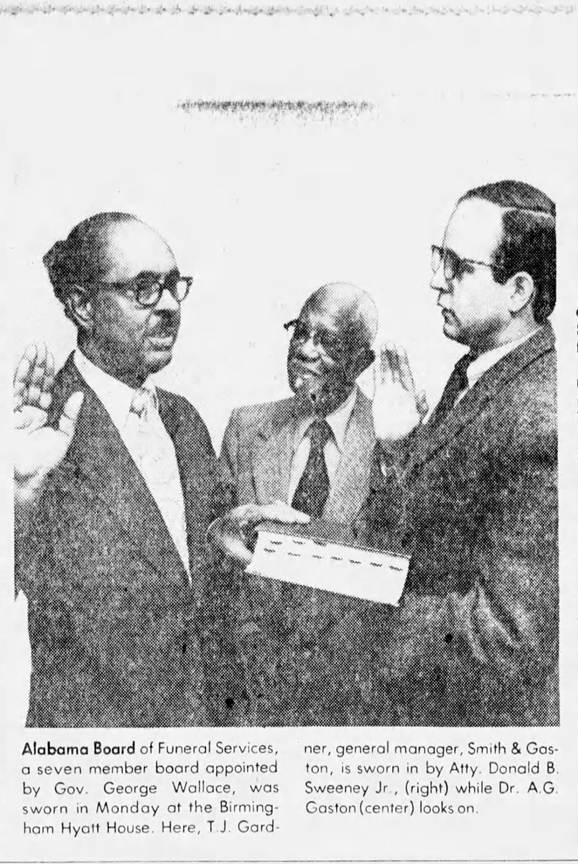
Then, however we see news reports in the December 2, 1975 edition of The Birmingham Post Herald, reporting on the Formation of the current Alabama Board Of Funeral Services, a seven-member board appointed by Governor George Wallace, was sworn in Monday at the Birmingham Hyatt House. Pictured on this news piece, are T.J. Gardner, General Manager, Smith & Gaston, being sworn in by Atty Donald B. Sweeney, Jr., (right) while Dr. A.G. Gaston (center) looks on.
BUT BEFORE THAT, FIRST, comes Edgar Battle vs. Liberty National Life Insurance Company et al.
It is crystal clear to me that what black funeral professionals were seeking in 1970, was advocacy, professional, entrepreneurial and business-related support. But, in reality, who was the regulating body going to govern? What would their powers entail? If not the Funeral Homes, who would be protected by the State Legislated governing body? Why would legislation need to be financed? If a particular practice by the burial insurance industry was believed to be predatory by those OTHER THAN THE BLACK FUNERAL HOME OWNERS WHO WERE SUBJECTED TO THEIR TREATMENT, why then, would a group of disadvantaged black undertakers need to FINANCE anything? Was that the ONLY WAY, they could free themselves from the monopolistic burial insurance industry? (cacf)
1969: Organization Key To Racial Progress Abernathy says
1969: Organization Key To Racial Progress Abernathy says
1969-7-19 [The B'ham News page 3]
The 1969 session of the Alabama Funeral Directors & Mortician's Association convened in Birmingham, Alabama, where SCLC President Ralph David Abernathy told delegates that black Americans cannot accomplish racial progress without organization AND PRESSURE.
I have no doubt that this meeting, this session, this speaker, were all part of a broader campaign stemming from that 1955 meeting wherein “Negro Undertakers Mapped Fight To Rid Selves of Burial Insurance Contracts.” It was the foreseeable consequence of decades of structural imbalance between insurance conglomerates and funeral service providers — an imbalance that Black funeral homes were uniquely ill-equipped to withstand due to historical discrimination embedded across Alabama’s economic and regulatory systems. And it was one year before the filing of the infamous Battle vs. Liberty National case.

![1970-10-6 [The-Birmingham-News-P31] Black Mortuaries File Antitrust Suits](http://cdn1.artcltn.com/storage/31679/01a019a6-d8e7-72b4-9040-eb3670c7387f/1970_tue_oct_6_the_birmingham_news_p31_black_mortuaries_file_antitrust_suits.jpg?w=800)
1970-10-6 [The-Birmingham-News-P31] Black Mortuaries File Antitrust Suits
1970: bLACK MORTUARIES
File Antitrust Suits
1970: bLACK MORTUARIES
File Antitrust Suits
Nine Black-owned Alabama funeral homes have filed a federal antitrust lawsuit against three Birmingham-based insurance companies, seeking $7,500,000 in damages [image_1apGyn.png].
Key Details of the Lawsuit
- The Allegation: The plaintiffs claim that Liberty National Life Insurance Co., Brown-Service Funeral Home Co., and Service Insurance Co. of Alabama conspired to create an illegal monopoly [image_1apGyn.png]. They accuse the companies of violating the Sherman and Clayton Anti-Trust Acts [image_1apGyn.png].
- The Impact: The funeral directors allege the insurance companies used boycotts, coercion, and intimidation to control the market [image_1apGyn.png]. They claim the companies grant unfair preferences to their own contracting businesses for vaults, caskets, and burial equipment, while completely shutting out independent funeral homes from burying individuals holding their policies [image_1apGyn.png].
- The Plaintiffs: Organized under the Progressive Funeral Directors of Alabama, the nine specific businesses involved span across Phenix City, Bessemer, Mobile, Montgomery, Anniston, Sylacauga, and Birmingham [image_1apGyn.png].
The plaintiffs have officially requested a trial by jury.
Here are the names of the nine Black-owned Alabama funeral homes and their locations as listed in the lawsuit:
- Edgar H. Battle Funeral Home – Phenix City, Alabama
- Armour Funeral Home – Alexander City, Alabama
- Johnsons Memorial Funeral Directors, Inc. – Bessemer
- Hodge's Chapel, LLC– Mobile, Alabama
- Cillie Funeral Home – Montgomery, Alabama
- Ervin Funeral Chapel – Anniston, Alabama
- Madden Funeral Home – Sylacauga, Alabama
- Perryman Funeral Home – Birmingham, Alabama
- Lumzy Funeral Home – Birmingham, Alabama
"They claim that the insurance companies, all wholly-owned subsidiaries of Liberty National Life Insurance Co., 'have by contract, mutual agreement and concerted action unlawfully combined and conspired to monopolize their business.'"
"The funeral home directors also charged the insurance companies have 'contracted and conspired to boycott, coerce and intimidate' them into 'either doing business with them or to terminate their business by loss of profits and its loss of business by refusing to do business with them.'"
![1970-10-8 The Anniston Star] Funeral Homes Sue Liberty National Life](http://cdn1.artcltn.com/storage/31679/01a019a6-d8e7-72b4-9040-eb3670c7387f/1970_10_8_the_anniston_star_funeral_homes_sue_liberty_national_life.jpg?w=1080)
Funeral Homes Sue Liberty National Life
![1970-10-8 The Anniston Star] Funeral Homes Sue Liberty National Life](http://cdn1.artcltn.com/storage/31679/01a019a6-d8e7-72b4-9040-eb3670c7387f/1970_10_8_the_anniston_star_funeral_homes_sue_liberty_national_life.jpg)
THE OCTOBER 8, 1970 ANNISTON STAR REPORTS ON
BLACK FUNERAL HOME ANTITRUST LAWSUIT
Nine Black funeral homes filed a $7.5 million antitrust lawsuit against Liberty National Life Insurance Co. and its subsidiaries, Brown-Service Funeral Co. and Service Insurance Co. of Alabama.
The lawsuit, filed in federal court in Birmingham, Alabama, by the Progressive Funeral Directors of Alabama, alleges antitrust violations in the burial business.
Key Details of the Lawsuit
- The Allegations: The suit claims that funeral directors are forced to enter contracts with the defendants to make a reasonable profit. It also asserts that independent, non-contracting funeral directors are only provided with a casket for policyholders' funerals rather than full service support.
- Liberty National's Defense: Ira L. Burleson, vice president and general counsel of Liberty National, called the suit "unjustified." He stated that the company has spent about 15 years operating diligently under a federal consent decree intended to prevent violations of the Sherman and Clayton Antitrust Acts.
- Broader Support: The Progressive Funeral Directors met with the white Northwest Funeral Directors Association, inviting its members to join the federal suit. At least one white funeral home indicated it would join as a plaintiff.
- Historical Context: The article is from The Anniston Star, dated Thursday, October 8, 1970. A similar antitrust lawsuit based on state laws was also pending in circuit court at the time, filed by a Gadsden funeral home.
1970 — BATTLE V LIBERTY NATIONAL LIFE INSURANCE COMPANY ET AL
Battle v Liberty National Life Insurance Company ET AL Case, Please Visit This Link
Historical records demonstrate that, even at this early stage, Black funeral directors striving for professional excellence and economic independence were met with persistent and systemic obstacles. These included restricted access to capital, exclusion from mainstream insurance and financial systems, and coercive business arrangements imposed through burial insurance contracts.
By at least the mid-twentieth century, a powerful and largely opaque nexus had formed between burial insurance companies and the funeral service industry in Alabama. This relationship, while detrimental to many funeral homes regardless of race, had a disproportionately damaging effect on Black funeral home owners due to preexisting racial disparities in access to capital, political influence, and legal recourse.
In the final analysis, it is not known, what became of the Alabama Negro Funeral Directors efforts to “Rid Themselves Of Burial Insurance Contracts” (June 30, 1955) however, out of the blue, we can definitely learn about the infamous Battle Case. This was a Case that involved 9 black funeral homes, who called themselves The Progressive Funeral Directors Of Alabama. Battle et al v Liberty National.
Contemporaneous reporting further reflects a consensus among Black funeral directors that state-level oversight was needed—not to control them, but to regulate burial insurance practices and protect funeral professionals from predatory arrangements. These discussions predate the formation of what is now the Alabama Board of Funeral Service.
In 1970, these long-standing tensions culminated in formal legal action. Nine Black-owned funeral homes filed an antitrust lawsuit against Liberty National Life Insurance Company, alleging monopolistic practices that restrained trade, restricted funeral home choice, and caused substantial economic harm. The plaintiffs included funeral homes located in Phenix City, Alexander City, Bessemer, Mobile, Montgomery, Anniston, Sylacauga, and Birmingham—demonstrating the statewide scope of the issue.
This litigation was not an anomaly; it was the foreseeable consequence of decades of structural imbalance between insurance conglomerates and funeral service providers—an imbalance that Black funeral homes were uniquely ill-equipped to withstand due to historical discrimination embedded across Alabama’s economic and regulatory systems.
Against this backdrop, it is deeply troubling—and revealing—that Black funeral professionals of that era were led to believe that the State of Alabama would establish a regulatory body for the primary purpose of protecting their interests. History demonstrates otherwise. The regulatory framework that emerged did not dismantle the structural inequities faced by Black funeral homes; instead, it often reinforced them through selective enforcement, disproportionate penalties, and regulatory overreach.
The historical record makes it crystal clear that the current conditions under which black Funeral Professionals must exist make it necessary to revisit this history. They are the modern manifestation of a long-standing pattern in which Black funeral service professionals in Alabama have been subjected to economic constraint, regulatory hostility, and institutional neglect under the guise of oversight and public protection.
Civ.A No. 70-H-752-S Consolidated
United States District for the North District Of Alabama Southern Division
Edgar H. Battle dba Edgar H. Battle Funeral Home et. al
Edgar H. Battle v. Liberty National Life Insurance Company is a landmark 1970 federal class-action lawsuit filed by 9 black Alabama funeral home owners against Liberty National Life Insurance Company. It alleged federal antitrust violations regarding the sale of "burial insurance" policies, which promised policyholders specific funeral services through designated funeral homes
1. The Burial Insurance System Was an Economic Power Structure
The litigation materials describe a system where Liberty National and Brown-Service essentially controlled:
Who could service burial policies,
How much funeral homes were paid,
Which merchandise could be used,
Which funeral homes families could choose
And even how funeral pricing worked during “oversales.”
That is enormous power. And because Black communities disproportionately relied on burial insurance, Black funeral directors were disproportionately trapped inside that system. The key issue was not simply insurance. It was market control through insurance.
2. “Authorized” Funeral Homes Created a Controlled Network
One of the most revealing parts of the Battle summary is the description of “authorized” funeral homes. Liberty National/Brown-Service maintained agreements with selected funeral homes, and policyholders effectively had to use those providers to receive full benefits.
That arrangement did several things simultaneously:
restricted competition,
(1) weakened independent funeral homes,
(2) forced compliance with insurer-controlled pricing, and
(3) created economic dependency.
For Black funeral homes, this was especially devastating because many already lacked:
(1) capital access,
(2) political protection,
(3) financing, and
(4) regulatory influence.
So the insurer relationship became almost unavoidable.
3. The Lawsuit Was About More Than Money — It Was About Freedom From Control
The 1970 plaintiffs accused Liberty National and Brown-Service of:
(1) monopolization,
(2) price fixing,
(3) tying arrangements, and
(3) restraint of trade under the Sherman Act.
That language matters.
They were essentially saying: “You have constructed a vertically integrated system where insurance controls funeral commerce.”
That is why the consent decree later prohibited: exclusive territories, exclusive servicing arrangements, and restrictions on funeral home participation.
The court understood there was a monopoly concern.
4. The Timing Is Historically Significant
The suit was filed in 1970 — only a few years after:
the Civil Rights Act,
Voting Rights Act,
desegregation battles,
and the expansion of Black economic assertion in the South.
Black funeral homes historically served as:
economic anchors, political organizing spaces, civil rights infrastructure, and sources of independent Black wealth. So when you view Battle through that lens, the stakes become much larger.
The case was not occurring in a vacuum.
It was unfolding during a period when Black-owned institutions were trying to gain genuine economic independence — and burial insurance structures were standing directly in the way.
Particularly important is this point:
“The regulatory framework that emerged did not dismantle the structural inequities faced by Black funeral homes; instead, it often reinforced them…”
That is a major thesis.
And frankly, the Battle materials already support parts of it.
Because what becomes obvious is:
(1) the system operated for decades,
(2) state regulation did not meaningfully stop it, and
(3) funeral industry professionals had to resort to massive federal antitrust litigation to challenge it.
That says a lot.
6. One of the Most Important Issues May Be “Regulatory Capture”
A deeper question underneath all this is whether:
Alabama regulators, insurance interests, and funeral industry power structures became intertwined in ways that effectively normalized economic practices harmful to independent Black funeral homes. Not necessarily through explicit racial statutes — but through systems that predictably produced racialized outcomes. That distinction matters historically and legally.
7. The Case Never Truly “Ended”
Legally, yes — the major consent judgment came in 1977–1978.
But the litigation kept resurfacing for years because policyholders later challenged:
notice issues, settlement fairness, oversale provisions, and the actual meaning of burial policy rights.
Judge Thompson even wrote in 1991 that the lawsuit had: “clung to life with a tenacity…”
That line is almost symbolic. Because the underlying tensions never fully disappeared.
Battle v. Liberty National can be interpreted as:
A civil rights-era economic struggle, disguised procedurally as antitrust litigation, arising from decades of unequal bargaining power, within a state-sanctioned burial insurance structure, that disproportionately constrained Black funeral enterprises.
That does not mean every action by Liberty National was illegal simply because racial disparities existed.
But it does mean the historical system deserves to be examined not only through antitrust law —
but through: (1) racial economics; (2) regulatory history; and (3) institutional power.
My family’s experience gives human dimension to what otherwise looks like abstract federal litigation.
Within this historical context we are attempting to connect:
(1) The courtroom;
(2) the industry;
(3) the regulators; and
(4) the lived consequences.
That is where the real story is. A structured historical timeline, a power-map of the players, and possibly a much larger interpretation of how Alabama’s burial insurance regime affected Black funeral professionals across generations.
HOW WAS BATTLE FINALLY SETTLED?
The Battle v. Liberty National Life Insurance Company lawsuit was primarily settled through a 1977-1978 consent decree that abolished the company's exclusive-provider, anti-competitive burial contract system, with a final judgment entered on January 6, 1978. The case originated from a 1970 antitrust lawsuit filed by Alabama funeral homes, which had "clung to life" for years, with further litigation extending into the 1980s.
Key Aspects of the Settlement:
(1) End of Monopoly: Liberty National was enjoined from entering new contracts that gave funeral directors exclusive territory to bury policyholders.
(2) Contract Cancellation: The company was ordered to cancel exclusive provisions in existing funeral service contracts.
(3) Fair Standards: The company was required to establish reasonable, uniform, and non-discriminatory standards for funeral directors to do business.
(4) Court Supervision: The District Court for the Northern District of Alabama retained jurisdiction to ensure compliance, with related litigation and challenges continuing for years after the 1978 judgment.
The case is notable for its long-lasting impact, with the 1977-1978 final judgment acting as the foundational settlement.
How interesting is it that even though the Battle decision has been classified and referred to as a “Landmark” case, up to this point in time, after much research, and digging into the history of this litigation, there have been only two publications to carry stories that chronicle this lawsuit.
THE PROGRESSIVE FUNERAL DIRECTORS OF ALABAMA
(Who Were They? Visit This Link For A Deeper Dive)
While I cannot make this assertion with any degree of certainty, it is my STRONG belief that each of the Plaintiffs in the Battle v Liberty National case, was part of a “splinter group” formed for that purpose alone, of litigating on behalf of the Alabama Funeral Directors and Mortician’s Association, so as not to have the litigation “taint” the parent group, but to facilitate the litigation through a separate entity.
We believe it was done as a precautionary measure. It was a generally accepted premise among black people that even if they were involved in any way, shape, form or fashion in challenging the White power structure, it was best not to let it be known that they were involved. So, the people who were named as plaintiffs were those who probably not afraid to have their names appear as litigants.
To The best of my knowledge and belief, the members of the “Progressive Funeral Directors” whose names were associated with the Battle litigation included: Edgar H. Battle dba Edgar H. Battle Funeral Home, Phenix City, AL, James L. Taylor, Aubrey J. Carr, E.S. Ray, Otis Armour Armour Funeral Home, Alexander City, AL, Eugene Ervin, Ervin Funeral Home, Anniston, AL, Johnson's Memorial Funeral Directors, Inc. Bessemer, Hodge Funeral Home, Mobile, Cillie Funeral Home, Montgomery, Simon T. Madden Funeral Home, Sylacauga, Alabama, Perryman Funeral Home and Lumzy Funeral Home, both in Birmingham.
Progressive Funeral Directors of Alabama
The Progressive Funeral Directors of Alabama was a prominent funeral service organization in the state, historically linked to the Alabama Funeral Directors and Morticians Association, Inc. (AFD&MA), which traces its roots to the mid‑1920s when African American funeral directors organized to address community‑specific needs.
While the AFD&MA’s founding group included leaders such as Robert A. Ross, A.L. Welch, C.W. Lee, Fred D. Williams, and others, we believe the “Progressive” designation often reflected a branch or leadership role within the association rather than a separate, formally named entity.
One notable figure connected to the Progressive Funeral Directors was Edgar H. Battle, who served as President of Progressive Funeral Directors of Alabama, Inc. Battle, born in 1909 in Barbour County, Alabama, was the founder of Edgar H. Battle Funeral Home in Phenix City in 1950, alongside his brother Willis C. Battle, Sr. He was active in the Alabama Funeral Directors and Morticians Association and the National Funeral Directors and Morticians Association, and his leadership in Progressive Funeral Directors underscored his influence in the state’s funeral industry.
The Progressive Funeral Directors, like other branches of the AFD&MA, were part of a broader network of funeral homes and directors who worked to uphold professional standards, advocate for members, and serve their communities. The association’s early meetings were held in private homes, Masonic lodges, and later in black schools, reflecting the challenges of segregation-era access to formal venues Alabama Funeral Directors and Morticians Association, Inc..
Key points:
- Progressive Funeral Directors of Alabama was a leadership or branch name within the AFD&MA.
- Edgar H. Battle was a prominent president of this group and a major figure in Alabama funeral services.
- The organization was part of a long‑standing tradition of African American funeral directors organizing to protect their profession and serve their communities.
The only publications that carried articles covering the Battle v. Liberty National Life Insurance Company case were the three leading daily newspapers at the time: The Birmingham News, The Birmingham Post-Herald, and The Anniston Star. As part of the formal findings documented in the litigation's final orders, the federal district court explicitly noted that intensive multimedia news coverage was utilized to provide widespread notice to policyholders. This included multiple articles published in these three primary daily newspapers, which had a general circulation throughout the entire State of Alabama. (cacf)
1975 THE ALABAMA BOARD OF FUNERAL SERVICE IS FOUNDED
Finally, 20 years after the Black Funeral Directors Association in Alabama vowed to push for the establishment of a regulating body, the Birmingham Post Herald, an Alabama Newspaper announced the formation of the Alabama Board of Funeral Service, which currently exists today. This goes to show you just how little attention anyone paid to the Negro Funeral Directors in Alabama.
The Birmingham Post Herald announced the formation of the Alabama Board Of Funeral Services, a seven-member board appointed by Governor George Wallace, sworn in Monday at the Birmingham Hyatt House. Pictured in the article is Mr. T.J. Gardner, general manager of Smith & Gaston Funeral Home, sworn in by Attorney Donald B. Sweeney, Jr. while Dr. A.G. Gaston (center) looks on.
A decision clearly influenced by the involvement of Organized Black Professionals in the Alabama Funeral Directors and Mortician's Association, it took TWO WHOLE DECADES for this long-hoped-for public regulating body to come to fruition.
What I still cannot fathom is how any NEGRO alive during that particular time period , with Jim Crow philosophy openly demonstrated and practiced statewide, could anyone in their right mind think that Any State Regulating Agency (PARTICULARLY OPERATING IN ALABAMA) would take any measures to protect Black Funeral Directors, against these mega corporations who were widely marketing burial insurance policies.
DESCRIPTION OF THE ALABAMA BOARD OF FUNERAL SERVICE
According to current information on the Alabama Board Of Funeral Services website:
The Alabama Board of Funeral Service, headquartered in Montgomery, AL, is the state's regulatory agency for the funeral profession. Established in 1975, it evolved from the former State Embalming Board to provide modernized licensing, regular facility inspections, and consumer protections across the state.
Key Milestones and Functions:
- 1975 Foundation: The Board was created by Act 1975-214, replacing the legacy Board of Embalming. It began actual office operations in early 1976, holding specialized meetings and nominations in Montgomery to seat its original members.
- 1975-2017 Growth: The agency's mandate was systematically expanded to require apprenticeships, supplemental inspections, and written examinations. In 2019, the Board was reconstituted to include both professional members representing each U.S. Congressional District and public consumer members.
- 2023 Preneed Expansion: Through Act 2023-94, the Board’s duties were significantly expanded to absorb the preneed funeral and cemetery responsibilities previously handled by the Alabama Department of Insurance. This resulted in the creation of two dedicated branches: the Funeral Division and the Preneed Division.]
- Current Operations: Today, the Board operates from its central office located at 4276 Lomac Street in Montgomery, AL. It processes licenses, manages apprentice requirements, and conducts hearings.
Charlotte A. Clark-Frieson, Wilkie Sherard Frieson, and Je’Lynn M. Frieson — who have been in the Funeral Home Industry since 1969, when Clark-Frieson was 14 years of age, can affirm — without equivocation — that for those early years after the formation of the Alabama Board of Funeral Service, The Agency existed, however, they allowed us to exist. It was widely known that they set policies and procedures and requirements for both individual licensees, as well as Funeral Home Establishments operating in Alabama, but beyond that, we were allowed to go about our business and live our lives. The state office was located on Hull Street in Montgomery, Alabama in a little wood frame house, where 3 to 5 people occupied the little office.
How do I know this? Because I visited this location, several times during my youth. The occupants included Warren Higgins (White), who was appointed the first Executive Director of the Board Of Funeral Service; the Associate Executive Director was Mr. Simon T. Madden (black) of Sylacauga, Alabama; and if memory serves me correctly, there may have been one maybe two ladies in that office who served as receptionists and performed clerical tasks. I do know that for many years, Mrs. Sherry Dawson was one of those individuals. From one year to the next, we could always look forward to an impromptu visit from Mr. Higgins, who would cordially come into the establishment with his clipboard, and checklist, start his walk-through, and inspect the Funeral Home, and just as quietly and reservedly as he came in, he was gone.
Not to be seen again until the following year.
Their oversight of the industry didn’t feel disruptive, overbearing or designed to turn everything topsy turvy. They were just there providing a service to bring order into what was previously regarded as the often-chaotic practice of Funeral Directing and Embalming in Alabama. To the best of my recollection, Mr. Higgins NEVER assumed a domineering posture or attempted to laud his authority over any of us. Plaintiffs are/were aware that they held meetings at regular intervals, and professionals were made welcome to attend Board meetings. Plaintiff is also aware that you went there to take your exams if you were applying for a new license or new category of licensure. They had clear-cut guides for Funeral Home Operation. And that was it. They pretty much stayed out of your business. Their existence in our lives was NEVER overpowering or uncomfortable.
A discussion of the Evolution of Preneed is essential to understanding this trajectory. No one outside of the immediate funeral industry can truly understand. No one not directly involved in our industry can truly understand the impact nor the challenges that have come with decades-long efforts to market Preneed.
For the purpose of discussion of the History Of Preneed as it evolved in Alabama, this writer, Charlotte A. Clark-Frieson references my 16- page “Preneed Position Paper” which I personally authored, written around 2022 as the new Alabama Preneed Funeral and Cemetery Act was on the verge of becoming the new state law governing the administration of Preneed in The State Of Alabama. Beginning on page 5, I discuss in detail the beginnings of “The Concept Of Preneed.”
However the entire booklet entails my presentation of how poorly Alabama has performed in their effort to oversee the Funeral Home Industry where the sale of Preneed is concerned. At the end of the day, I question WHY the sale of a Preneed Funeral has to be monitored with a finely-toothed comb, to the extent of having to subject ourselves to intrusive high level financial examinations, and arbitrary audits as if we are Insurance companies — WHICH WE ARE NOT AND HAVE NEVER BEEN?
Some way some how — and how, I cannot tell you because we were not involved in any meaningful way — Alabama later came out with The Alabama Preneed Funeral and Cemetery Act. That is... until 2002, when under the pretense of protecting consumers, WE BLACK Funeral Directors in Alabama were BLINDSIDED by the Alabama Preneed Funeral and Cemetery Act. This act was Alabama’s first attempt at regulating the sale of Preneed Funerals. AND I DARE SAY, A MISERABLE ONE.
15 Years passed between that meeting in June of 1955, and December of 1975, when the Alabama Board Of Funeral Service was formed. That should tell you, if Black Funeral Directors were the ones pushing FOR the formation of a regulatory Board, obviously nobody gave a dam about what they wanted or felt like they needed in order to experience fairness in the pursuit of their business endeavors. As a matter of fact, it took a group of rebellious — yet courageous black business-owners called the Progressive Funeral Directors of Alabama, to file an Anti-Trust lawsuit against Liberty National Life Insurance Company, to REALLY get the attention of Burial Insurance Companies. (cacf)
Moore v. Liberty National Life Insurance Co. (filed in December 1999)
Another loosely related controversy that provides a very clear reflection of how African-Americans have been systemically disregarded in Alabama involves the above-referenced Moore v. Liberty National Life Insurance Company controversy.
The landmark civil rights class-action lawsuit most prominently associated with challenging race-based life insurance rates in Alabama during this period is Moore v. Liberty National Life Insurance Co. (filed in December 1999).
The suit was filed by the Birmingham-based law firm, Whatley Drake, LLC, (now known as Whatley Kallas, LLP) alongside the San Francisco-based firm Millberg Weiss Bershad Hynes & Lerach.
The primary action and historical context include the following details:
The Case:
Filed in the U.S. District Court for the Northern District of Alabama, the lawsuit (and related nationwide litigation) charged major insurers with racial discrimination for targeting Black Americans—particularly low-income individuals—with "industrial life" or burial insurance policies that carried higher premiums and yielded lower benefits than those sold to white customers.
The Commission:
Plaintiffs argued that the Alabama Insurance Commission and state regulatory framework enabled or tolerated these discriminatory, race-based premium structures for decades under the guise of "actuarial tables".
The Resolution:
Liberty National and other major insurers (such as American General Life and Accident and Life of Georgia) ultimately faced extensive litigation. Many of these class-action lawsuits resulted in multi-million-dollar settlements that provided premium refunds, death benefit increases, and fines.
FURTHER EXPLANATION:
The Nationwide Insurance Settlements
The wave of multi-million dollar settlements during the early 2000s resulted from coordinated actions by state regulators and federal class-action lawsuits. Regulators discovered that major life insurance companies had stopped issuing new race-based policies after the Civil Rights Era, but they continued collecting racially inflated premiums from elderly Black policyholders for decades.
American General Life & Accident:
In June 2000, American General agreed to a $206 million settlement. The company had acquired smaller entities that utilized dual-pricing systems based on race. The settlement affected roughly 9.1 million "industrial" or burial life insurance policies. It provided cash refunds, reduced active premiums, increased death benefits, levied $7.5 million in state regulatory penalties, and contributed $2 million to the NAACP.
Liberty National Life Insurance:
Stemming from the Moore v. Liberty National litigation in Alabama, a federal judge approved a settlement addressing the company's historical practices of selling industrial policies with higher premiums and lower payout caps to Black customers.
Other Major Insurers: The litigation swept the entire industry. Metropolitan Life Insurance Co. (MetLife) settled similar claims for $157 million, John Hancock settled for $24.4 million, and companies like Mutual Savings Life also paid out millions to resolve claims of systemic overcharging.
How Race-Based Mortality Tables Justified Premiums
In the late 19th and early 20th centuries, insurance companies openly relied on race-based mortality and actuarial tables to justify charging Black Americans higher premiums (often 30% or more) for identical or inferior coverage.
│
▼ (Higher Black mortality rates due to Jim Crow socioeconomic conditions)
[Actuarial Evaluation]
│
▼ (Insurers treat race as an immutable, biological risk factor)
[Dual-Rate Books]
│
▼ (Agents use "White" vs. "Black" pricing structures for door-to-door sales)
1. Conflating Socioeconomic Disparity with Biological Risk
In 1881, an internal Prudential survey noted that Black mortality rates were significantly higher than white mortality rates. In 1896, statistician Frederick L. Hoffman published an influential actuarial study for the industry arguing that Black Americans were inherently prone to shorter life expectancies and higher disease rates. Insurers used these data points to argue that they were practicing "fair discrimination" based on purely objective, statistical mathematical risks.
2. Ignoring Systemic Realities
The mortality tables strictly recorded deaths without adjusting for the severe, systemic impacts of Jim Crow segregation, poverty, poor workplace safety, malnutrition, and a near-total lack of access to healthcare. Actuaries treated race as a static biological indicator of risk rather than a reflection of socioeconomic deprivation.
3. Institutionalizing the Dual-Rate Book System
Using these tables as legal cover, insurance companies issued separate pricing structures for agents on the ground. Door-to-door agents carried physical dual-rate books — one containing cheaper rates for white customers and another with heavily inflated rates for Black families purchasing standard burial or industrial life policies.

The Alabama Department Of Insurance
2002: Alabama Funeral Directors Desiring to Market Preneed
Come Under Alabama Insurance Commission
2002: Alabama Funeral Directors Desiring to Market Preneed
Come Under Alabama Insurance Commission
The passage of the Alabama Preneed Funeral and Cemetery Act of 2002 blindsided Black funeral professionals by placing preneed regulations under the Alabama Department of Insurance. This effectively split oversight forced a single profession to answer to two separate state agencies, doubling the burden of rules, compliance timetables, licensing tracks, and operational fees.
To legally market preneed contracts, small funeral homes faced intense systemic and financial hurdles:
Dual Licensure Fees: Establishments must secure a Certificate of Authority (COA) for $180, while individual staff members must maintain a Preneed Sales Agent (PSA) license for an annual $35 fee.
Complex Financial Reporting: The state requires the submission of an intricate, 19-page GAAP format financial statement. This treats independent, rural "mom-and-pop" businesses with the same rigorous standard applied to Fortune 500 corporations.
Systemic Exclusion: Because few minority-owned firms operate with the capital to retain specialized corporate accountants, these hyper-complex requirements function as a modern "Jim Crow Law" or "Black Code". The regulations effectively discourage, impede, and exclude Black entrepreneurs from competing in the profitable preneed marketplace.
Ultimately, this regulatory structure operates less as genuine consumer protection and more as an aggressive, punitive policing mechanism that violates basic financial privacy and drives economic attrition across generations of independent Black funeral homes.
CONCLUSION
We conclude this discussion of our collective experiences as life-long Funeral Service practitioners in the State Of Alabama in this way:
In the final analysis, and under the totality of our present circumstances, there is NO theory under which either of us believes, knows or understands the State Of Alabama to have EVER demonstrated any degree of fairness or sense of economic equity, parity, decency, or consideration for the extreme financial burdens, hardships, oppressions, or inequities that have been heaped/forced/levied upon it’s black citizens. It is that way now, and it has always been that way. Despite the earlier beginnings of the Alabama Board Of Funeral Service, it is unfortunate yet true that with the passage of time, our state has taken on a HARSHER, MORE PUNITIVE regulatory posture toward its professional population of Funeral Service Practitioners, with NO effort to understand the economic oppression(s) under which we have been traditionally forced to exist. At day’s end, the historical record establishes that the State of Alabama's regulatory bodies have consistently maintained a punitive posture toward Black practitioners. Given this documented multi-generational trajectory, the current fee models and enforcement traps cannot be viewed as neutral administrative updates; they operate as a foreseeable continuation of economic attrition. Don’t they see that they have a vested interest in our COLLECTIVE SUCCESS??
This is the legacy that Charlotte A. Clark-Frieson has inherited from her own parentage; and unfortunately without some kind of earth-shattering intervention, this is the legacy that she will undoubtedly yet unintentionally pass on to her biological children, Wilkie Sherard Frieson, and Je’Lynn Mikele Frieson.
"This digital monograph is an active, original historical compilation authored by Charlotte A. Clark-Frieson and Wilkie S. Frieson, utilizing primary archival sources, family records, and registered historical landmarks of Randolph County, Alabama. All rights reserved."