CLARK HISTORIC LANDMARK SITE ROANOKE, ALABAMA
The Terry Family Legacy: From Roanoke to the World Stage | Clark Historic Site


Less than a mile from what is now Clark Funeral Home, Jessie (also reported as "Jesse") A. Terry and his wife, Velma Heard Terry, laid the foundation for what would become one of the most successful African American-owned manufacturing companies in the United States.
What began in a modest, one-room operation would grow into a business that reached far beyond the boundaries of Randolph County… and ultimately, far beyond the nation itself.
"Humble Beginnings: A Vision Takes Root"
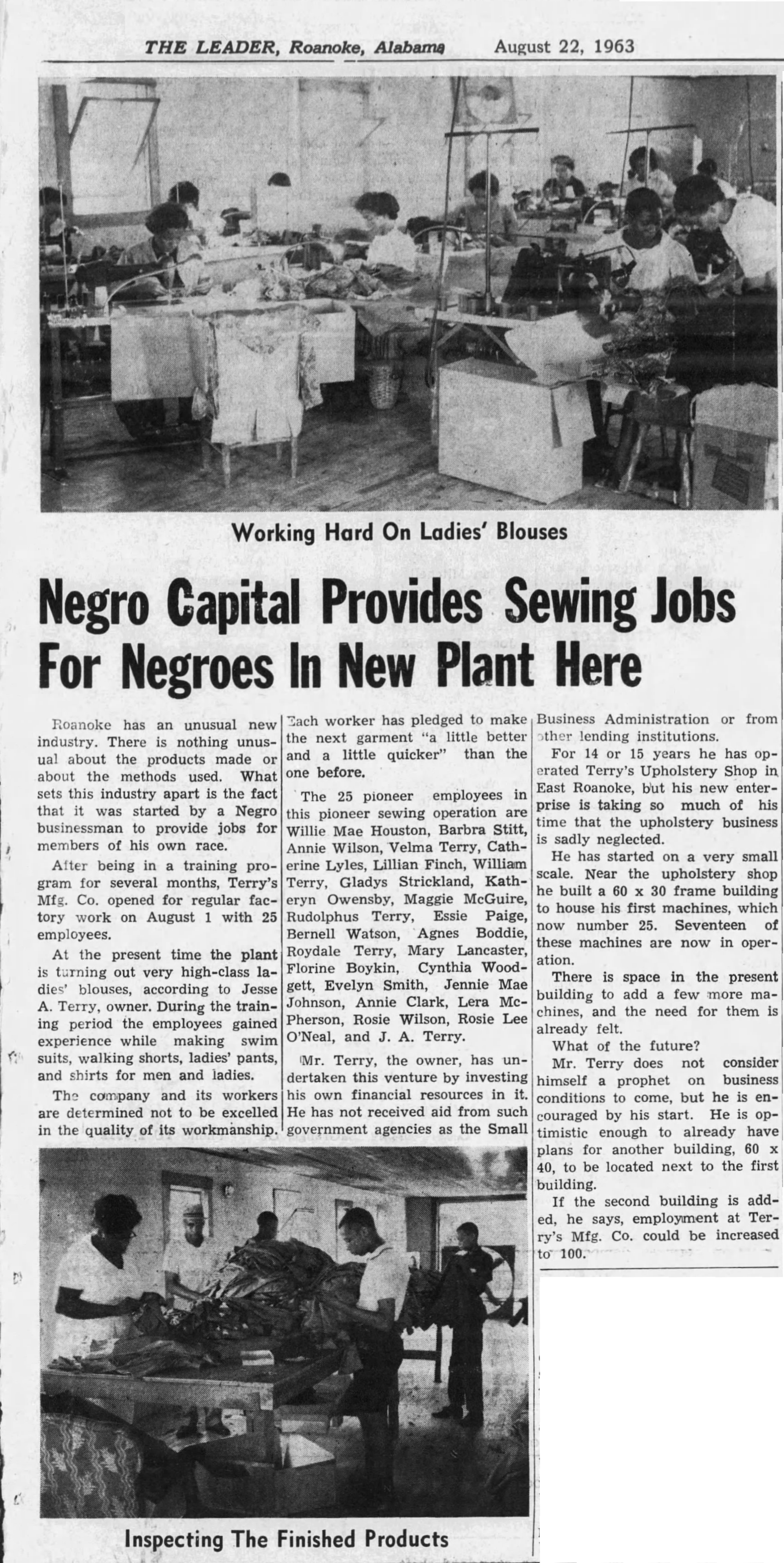
On August 1, 1963, as documented in The Roanoke Leader, Terry Manufacturing Company opened with just 25 employees, producing ladies’ blouses.
Operating under modest conditions but guided by a commitment to excellence, the company quickly distinguished itself through quality workmanship and disciplined production. Each garment reflected a standard that would come to define the Terry name—precision, pride, and continuous improvement.
From these humble beginnings, something extraordinary began to take shape.


At the center of this success was not just a business—but a family.
Jessie A. Terry and Velma Heard Terry instilled in their household the values of hard work, education, and unity. Their vision was carried forward by their three sons:
- Roy D. Terry
- Rudolph Terry
- Reverend William Terry
Together, the Terry family combined practical experience with advanced education, creating a powerful model of generational progress and excellence.
"Jesse Terry Day" — A Moment Of National Recognition
In October 1969, the impact of Terry Manufacturing and its founder was recognized on a national scale with the observance of “Jesse Terry Day.” What began as a local celebration quickly gained widespread media attention, with newspapers across the country highlighting the significance of this moment.
"Growth, Expansion, and National Recognition"
With strong leadership and a clear vision, Terry Manufacturing grew rapidly.
What began as a small garment operation evolved into a large-scale manufacturing enterprise, providing employment opportunities for numerous individuals in the Roanoke area and beyond. The company became known for its reliability, efficiency, and ability to meet demanding production standards.
In time, Terry Manufacturing secured major government contracts and expanded its reach into national and international markets. The company’s work would include the production of garments on a global scale—reportedly including apparel associated with the Olympic Games.
At its height, the Terry family stood among the ranks of African American multimillionaire business leaders, a rare and significant achievement—particularly for a company rooted in a small Southern town.
"Impact on Community and Legacy of Empowerment"
Beyond financial success, the Terry family’s impact was deeply felt within the community.
Their business created jobs, opened doors, and demonstrated what was possible for African American families in an era when such opportunities were often denied. They became a source of inspiration—not only in Roanoke, but for all who believed in the power of ownership, education, and perseverance.
Their story stands as a powerful example of economic empowerment, showing that success could be built from the ground up—even under the most challenging circumstances.
"Beyond Business: A Commitment To Civil Rights"
While the Terry family achieved remarkable success in business, their contributions extended far beyond economic enterprise.
Members of the Terry family were actively engaged in the Civil Rights Movement in Roanoke and Randolph County— standing alongside local leaders, including Wilkie Clark, whom they regarded as a mentor in civil rights.
They participated in marches, community organizing efforts, and the ongoing struggle for equality, demonstrating that their commitment to progress was not limited to business success, but extended to the advancement of their community as a whole.
"A Legacy That Endures"
Like many great enterprises, the story of Terry Manufacturing would experience later challenges. Yet, those chapters do not define the legacy—they add depth to it.
What remains undeniable is what the Terry family accomplished:
- They built.
- They employed.
- They led.
- They inspired.
And in doing so, they secured their place in history—not only as successful entrepreneurs, but as pioneers of possibility.
The Terry Family Legacy: A Celebration of Excellence, Enterprise, and Community Alignment
This archival broadcast of the television series "HERE WE ARE," originally aired on August 2, 1996, on the Chicago Access Television Network, features a live interview with Mr. Roy Terry, President and CEO of Terry Manufacturing Company.
Based out of Roanoke, Randolph County, Alabama, Terry Manufacturing stands as one of the most significant and inspiring stories of Black economic empowerment and industrial triumph in twentieth-century American history.
In this historic television feature, explore how a visionary enterprise founded in 1963 by Jesse A. Terry and Velma Heard Terry grew from a modest local sewing operation into a nationally and internationally recognized manufacturing powerhouse. Rooted in elite academic preparation — including the couple's three sons, who all earned MBAs from Morehouse College—the company expanded to secure major federal government contracts and produce global apparel for stages like the Olympic Games.
Crucially, the family's relentless focus on economic expansion went hand-in-hand with their deep dedication to local progress. Members of the Terry family were deeply engaged in the localized struggle for civil rights, proudly standing alongside local movement leader Wilkie Clark, whom they deeply respected and regarded as a direct civil rights mentor.
Together, their coordinated community organizing, marches, and mutual dedication to breaking down economic barriers left an indelible mark on East Alabama. This episode serves as an enduring testament to the heights that professional strategy and community-first leadership can achieve.
Production Credits:
Host: Hosted by journalist and writer Ms. Tonita R. Cheatham.
Production: Produced, directed, and written by Henry B. Cheatham, with associate production by Tonita R. Cheatham.
The Roanoke Leader – August 22, 1963
Documenting the early days of Terry Manufacturing Company and its initial workforce.
The following articles represent a small selection of the widespread national coverage surrounding “Jesse Terry Day.”